
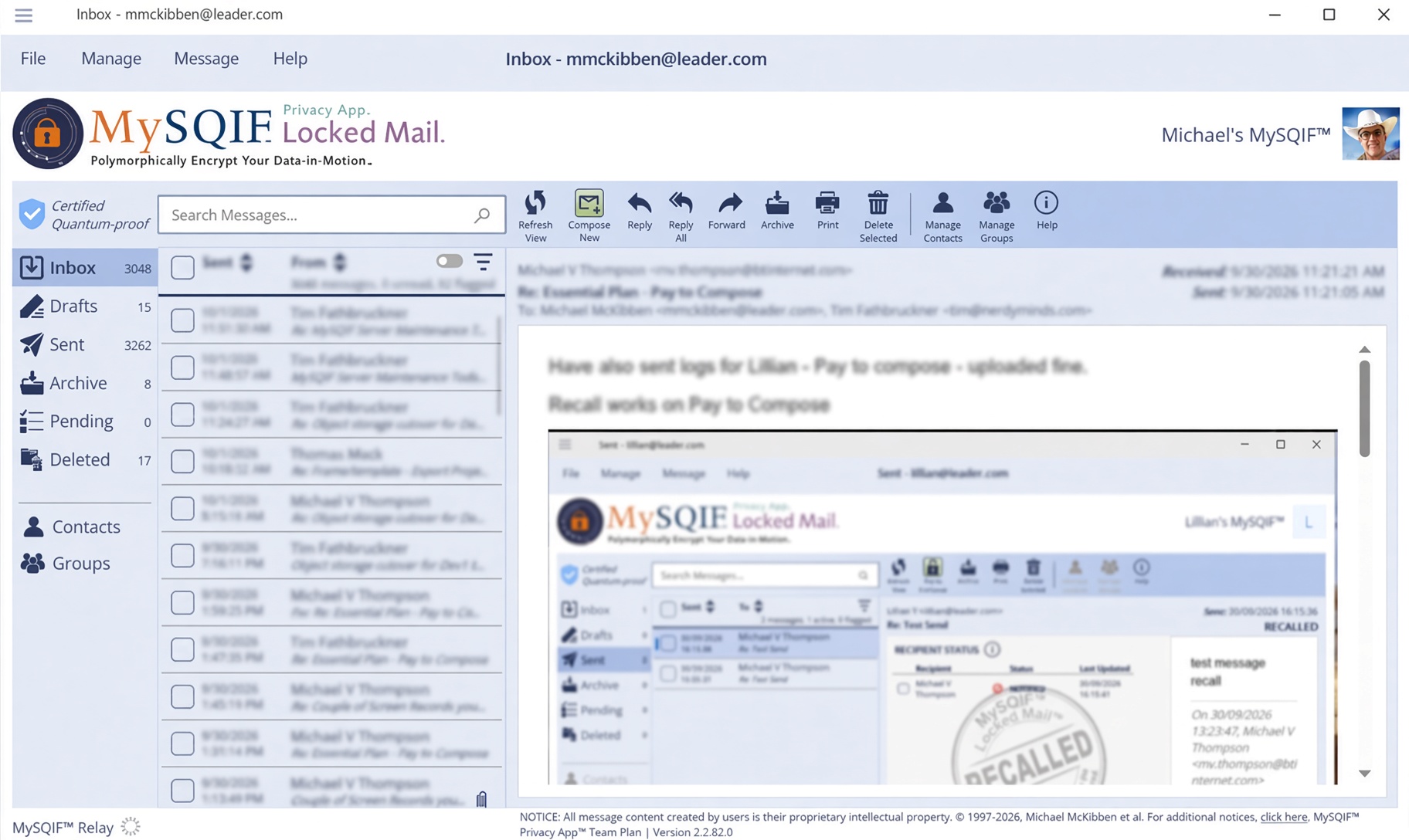
MySQIF™ Locked Mail™ is the world’s first true polymorphic encryption messaging system able to handle 4 GB files and built to put privacy, free speech, and control back in the user’s hands. For 33 years after PGP in 1993, electronic message encryption barely moved. Six years of intensive R&D changed that. Polymorphic encryption designed by Dr. Albert Carlson—independently certified against AI and quantum attack—combines with single-use keys that dissolve after each message, an advanced key-exchange that locks even the To, From, Subject fields, and extreme sharding that splits each payload into 20,000+ dual-key fragments. The interface, shaped by email pioneer Michael McKibben.
Independently tested and certified by respected institutions as resistant to both classical and AI-quantum computing attacks. No one has successfully broken MySQIF™’s encryption, even with quantum approaches. The system is backed by a $20,000 Crack-it! Prize for anyone who can crack it.
Designed by the same team that publicly demonstrated critical side-channel vulnerabilities in major encryption standards in 2015. MySQIF™’s architecture makes traditional side-channel attacks (timing, power analysis, cache, electromagnetic, acoustic, etc.) irrelevant.
Michael McKibben designs large-scale communications systems. He rebuilt the AT&T AccessPlus 3.0 email system in time for the release of Windows 95. After supporting AT&T’s global operation and its largest clients, he concluded that big-box technology had a fatal flaw in how it implemented large-scale collaboration, and that the industry was committed to its old wineskins. He formed Leader® Technologies to invent and patent what came to be called social networking. With the invention in hand, he was directed to a prominent Washington, D.C., patent professor to protect the work.
Just as he was teaming with the cryptologist Phil Zimmermann to implement encryption, his patent attorney formed the Eclipse Foundation with IBM and secretly shared the invention with big government and big tech. They began exploiting it under the cover of fourteen different origin stories meant to explain how they had obtained his source code. That account is set out in his new book, The Hidden Hand.
McKibben then turned to historical investigation to make sense of this breach of the U.S. Constitution. Along the way he met the eminent cryptologist Albert Carlson, Ph.D., and Carlson’s business partner, Michael Del La Garza. The three decided to build a new file-sharing and messaging system, combining McKibben’s software design with Carlson’s groundbreaking work in polymorphic encryption.
They launched the MySQIF™ Privacy App™ two years ago for file sharing. This release, MySQIF™ Locked Mail™, sharply improves the usability of the system so that, on the surface, it works like email. The polymorphic exchange of one-time keys is simultaneously powerful and invisible to the user. There are no fiddly encryption keys to manage, yet the result is the most powerful messaging platform encryption ever offered.

Professor Albert Carlson, Ph.D., has built a distinguished 30-year career across academia, industry, and the military in mathematics, physics, and cryptography. His work has spanned teaching, research supervision, and applied technical practice, linking theoretical training with operational problems in secure communications and electronic systems. He is currently on the faculty of Austin Community College and, at the same time, serves on doctoral committees for Ph.D. candidates at institutions around the nation.
The range of that career is best seen in the institutions and forums with which he has been associated: the University of Illinois at Urbana-Champaign and the University of Illinois at Chicago; U.S. Army Tactical and Strategic Electronic Warfare; the Illinois Institute of Technology; Mankato State University; the University of Idaho; Fontbonne University; and Austin Community College. He has also contributed in professional and technical settings that include DefCon 23, ShowMeCon, aQED, and the IEEE. Together these appointments and engagements mark a career that moves between the classroom, the laboratory, the field, and now into commercial software.